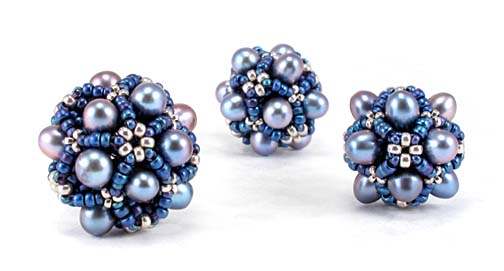
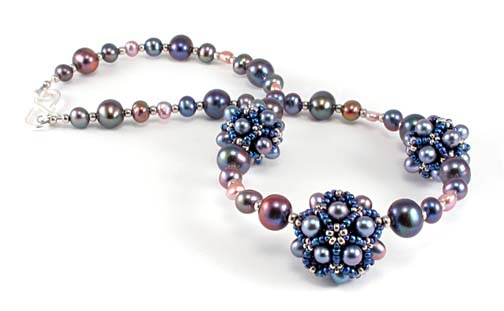
Here is my latest beaded bead using my Ionic Polyhedra weave. This one is based upon the rhombic dodecahedron. It is 33 mm wide and composed of over 600 beads. I am happy with the way it came out because it is reasonably stiff and very hollow. Because it is so hollow and the holes are so large, my boyfriend says it looks like a geode. I like the way you can see all the way through 4 different holes simultaniously. The first photo shows this.
The second photo shows a different type of hole in this beaded bead.
After I took these photos, I found another way to hold it that shows two holes. In this view below, the large purple crystals in the back show through the holes in the front, falsely making the beaded bead appear solid.
The rhombic dodecahedron is the dual of the cuboctahedron. Below I show the dual correspondence between these two polyhedra, using my Mini Ionic Polyhedra weave. I tried to pose the pair of beaded beads so that little gold beads have the same configuration in each photo.
The cuboctahedron is on the left and the rhombic dodecahedron is on the right. Because they are duals of one another, one has faces where the other has corners. In terms of beaded beads, one has holes where the other has stars of seed beads.
These two little beaded beads are just two centimeters wide, and they are each composed of exactly 288 beads.
Tuesday, September 28, 2010
Monday, September 27, 2010
Design Team Call for Seed Beaders
Are you a seed bead weaver?
Do you want to get free patterns from beAd Infinitum?
Do you want a this fancy banner to adorn your blog or website?
Do you want to get free patterns from beAd Infinitum?
Do you want a this fancy banner to adorn your blog or website?
Florence and I just put out a call for talented seed beaders who would like to join our design team. Team members get free beAd Infinitum patterns of their choice, each month of the term. In return, team members make and publicly display jewelry on the internet using our patterns.
See all the details here:
beAd Infinitum Design Team Call
Deadline for submissions: Sunday, October 24, 2010.
See all the details here:
beAd Infinitum Design Team Call
Deadline for submissions: Sunday, October 24, 2010.
Wednesday, September 22, 2010
Ionic Polyhedra Beaded Beads
Both photos above show the Ionic Antiprism. Even with that large hole, it still holds its shape.
My beading buddy Florence and I have been playing around with herringbone stitch for a couple years now, with a recent focus on herringbone cables with just 3 beads per round. We like the 3 bead version because you get a narrow cable that has enough detail to be decorative, but it doesn't take too much time to weave.
At beAd Infinitum today, we released our newest pattern for weaving beaded beads, the Ionic Polyhedra using a curved version of the herringbone 3-cable. The idea for the Ionic Polyhedra was based upon a beaded cube that Florence made first. Florence sent me a photo of her beaded cube, and when I beaded copies, the two in the above photo (center and right), I refined her design to make the beads fit together snugly, and I added some tiny drop embellishments. The resulting columns of beads remind me of Ionic columns from ancient Greek buildings. So I named the technique "Ionic," and I began applying it to a wide variety of different geometric objects, like the octahedron shown above (left).
I started writing this pattern back in April, and I just finished adding the reviewers comments today. (Thank you Florence and Cindy!) To date, this is the longest beading pattern I have ever written, 24 jam-packed pages, with over 90 illustrations and photographs. I was surprised and happy to find out how many different polyhedra look good as Ionic Polyhedra beaded beads, so I kept weaving more and more different shapes with this technique. The pattern is so long because I wanted to include all of the different designs. In particular, I used seven different geometric objects to weave beaded beads in each of two sizes, for a total of 14 different beaded bead designs. I'm sure there are other beautiful Ionic Polyhedra, but at some point I had to declare the pattern finished.
I wrote and illustrated detailed instructions for the cube and octahedron (see above photo) with advanced-beginning bead weavers in mind. This part of the pattern includes every relevant detail I could think of, including some of the underlying mathematics. For more advanced weavers, I include lengthy descriptions of how to create other shapes using this technique (including those shown here) and a three page spread showing the steps for an Ionic Icosahedron. A handy table includes seven different geometric objects that I use to design beaded beads, and I include detailed photographs and written explanations describing them all, including bead counts and sizes so you can make them all yourself.
The pattern ends with photos and a discussion for making Mini Ionic Polyhedra, some of which are small enough for light earrings. Finished bead sizes range from 11mm for the Mini Ionic Cube, all the way to 40mm for the Ionic Icosahedron, and everything in between.
I think the Ionic Pentacluster above looks like a frilly spaceship.
Check out the Ionic Polyhedra to see links to more photos or purchase the pattern.
You can read what Florence has to say about the Ionic Polyehdra on her blog.
My beading buddy Florence and I have been playing around with herringbone stitch for a couple years now, with a recent focus on herringbone cables with just 3 beads per round. We like the 3 bead version because you get a narrow cable that has enough detail to be decorative, but it doesn't take too much time to weave.
At beAd Infinitum today, we released our newest pattern for weaving beaded beads, the Ionic Polyhedra using a curved version of the herringbone 3-cable. The idea for the Ionic Polyhedra was based upon a beaded cube that Florence made first. Florence sent me a photo of her beaded cube, and when I beaded copies, the two in the above photo (center and right), I refined her design to make the beads fit together snugly, and I added some tiny drop embellishments. The resulting columns of beads remind me of Ionic columns from ancient Greek buildings. So I named the technique "Ionic," and I began applying it to a wide variety of different geometric objects, like the octahedron shown above (left).
I started writing this pattern back in April, and I just finished adding the reviewers comments today. (Thank you Florence and Cindy!) To date, this is the longest beading pattern I have ever written, 24 jam-packed pages, with over 90 illustrations and photographs. I was surprised and happy to find out how many different polyhedra look good as Ionic Polyhedra beaded beads, so I kept weaving more and more different shapes with this technique. The pattern is so long because I wanted to include all of the different designs. In particular, I used seven different geometric objects to weave beaded beads in each of two sizes, for a total of 14 different beaded bead designs. I'm sure there are other beautiful Ionic Polyhedra, but at some point I had to declare the pattern finished.
I wrote and illustrated detailed instructions for the cube and octahedron (see above photo) with advanced-beginning bead weavers in mind. This part of the pattern includes every relevant detail I could think of, including some of the underlying mathematics. For more advanced weavers, I include lengthy descriptions of how to create other shapes using this technique (including those shown here) and a three page spread showing the steps for an Ionic Icosahedron. A handy table includes seven different geometric objects that I use to design beaded beads, and I include detailed photographs and written explanations describing them all, including bead counts and sizes so you can make them all yourself.
The pattern ends with photos and a discussion for making Mini Ionic Polyhedra, some of which are small enough for light earrings. Finished bead sizes range from 11mm for the Mini Ionic Cube, all the way to 40mm for the Ionic Icosahedron, and everything in between.
I think the Ionic Pentacluster above looks like a frilly spaceship.
Check out the Ionic Polyhedra to see links to more photos or purchase the pattern.
You can read what Florence has to say about the Ionic Polyehdra on her blog.
Friday, September 17, 2010
Cindy's New Ballon Box Pattern
Several months ago, Florence Turnour and I decided to invite, Cindy Holsclaw (also known as beadorigami) to feature some of her beaded bead patterns on our website, beAd Infinitum. We found her beaded bead designs to be innovative, beautiful, and well designed, so we were obviously thrilled when she decided to join us. Today, we are releasing her newest pattern, the Balloon Box.
I made a Ballon Box while I was reviewing her pattern, and I must say, they are very satisfying to weave. They are wonderfully tactile since they are a wee bit of squishy, yet they always spring back into place. I'm completely fascinated at how the Balloon Box looks with pearls and metallic seed beads. Cindy, you found a beautiful way to update the pearl necklace!
MAA Poster
Sunday, August 8, 2010
Fuzzy Hoodie Suit with Ears Horns and Tail
I just finished my first full body suit. It's made out of faux fur with a polyester cuddle fabric lining. With all of its furry goodness, it reminds me of a cross between an abominable snowman costume and something from "Where the Wild Things Are." It has a hoodie-type hood with horns and ears. This was a commissioned piece, completely made to order.
I started with a muslin mock up made from Simplicity Pattern 2853, size small, plus I added a two piece hood. I also lengthened the sleeves and pants to be too long for the fitting. My client and I arranged for a fitting of the mock up. With him dressed in the muslin suit, inside out, I added a bunch of safety pins to fit the suit to his build. I pinned the cuffs and pant hems, I took in the width of legs significantly, and also in the hips, waist and a little in the chest. I drew on the placement of the side seam pockets and the inside patch pockets exactly where he wanted them. I also marked where the bottom of the opening should start. Then he got out of the suit, and I penciled where the seam should be as identified by the pins, removed the pins, ripped the muslin apart into its component pieces, transferred the markings to the paper pattern, added seam allowances back in, and my pattern was ready to go.
With the pattern in hand, I cut out the lining and fake fur, trimmed all of the fur out of the seam allowances, and serged all of the pieces including the lining. I sewed the fur pieces together and all of the lining pieces together. Then I added ears, horns, and a tail.
Normally, with a fur coat, I machine sew the lining to the fur, right sides together, up one side of the front lapel, across the shoulders, and down the other side. This leaves just the bottom hems and cuffs to finish by hand. However, because the particularities of this suit, I decided to finish everything entirely by hand. It's more work, but I have much more control when hand sewing, so I could finish all of the corners neatly. Adding the lining by hand required that I cross stitch all of the hems of the fur around both cuffs, pant hems, and the whole front opening (including hood). You can see the cross stitching in many of the photos below. I also added five extra-large hook and eye clasps along the front opening. It took me a few tries to figure out a good way to start adding the hooks, but if you look at the photo below, you can see the first two stitches that are adequate to anchor the hook efficiently.
Here's what a hook looks like after it's sewn, before it's covered with the lining.
I was worried that the fabric would rip at the bottom of the front opening, so I added a patch of flannel (it matches the pockets) with multiple rows of stitching across its width, an a tons of knots.
I also cross stitched down the seam allowance where the hood meets the neckline, under the arm pits, and at the crotch. I did this to reduce bulk. This photo shows an armpit.
Then, I added the lining. In addition to stitching all around the openings, I also tacked the lining to the fur in the bottom third of the arm hole seam, on the crotch seams, and where the hood meets the neckline. I added my tag and it's done! Here you can see where the lining meets the fur at the front opening.
Today, the suit's new owner came over to try it on and he let me take photos. Yeah. We were both very happy with the fit, and he was amazed that the seams blended right in. He couldn't even feel them. I really enjoyed this project and we are both super happy with the results. I put a little piece of my heart and my best workmanship skills into making this suit, inspired by the vision and enthusiasm of my client. I joked that it's industrial strength, a family heirloom, so he can stay warm on the Playa at Burning Man, in his new fuzzy suit for many, many years to come.
I started with a muslin mock up made from Simplicity Pattern 2853, size small, plus I added a two piece hood. I also lengthened the sleeves and pants to be too long for the fitting. My client and I arranged for a fitting of the mock up. With him dressed in the muslin suit, inside out, I added a bunch of safety pins to fit the suit to his build. I pinned the cuffs and pant hems, I took in the width of legs significantly, and also in the hips, waist and a little in the chest. I drew on the placement of the side seam pockets and the inside patch pockets exactly where he wanted them. I also marked where the bottom of the opening should start. Then he got out of the suit, and I penciled where the seam should be as identified by the pins, removed the pins, ripped the muslin apart into its component pieces, transferred the markings to the paper pattern, added seam allowances back in, and my pattern was ready to go.With the pattern in hand, I cut out the lining and fake fur, trimmed all of the fur out of the seam allowances, and serged all of the pieces including the lining. I sewed the fur pieces together and all of the lining pieces together. Then I added ears, horns, and a tail.
Normally, with a fur coat, I machine sew the lining to the fur, right sides together, up one side of the front lapel, across the shoulders, and down the other side. This leaves just the bottom hems and cuffs to finish by hand. However, because the particularities of this suit, I decided to finish everything entirely by hand. It's more work, but I have much more control when hand sewing, so I could finish all of the corners neatly. Adding the lining by hand required that I cross stitch all of the hems of the fur around both cuffs, pant hems, and the whole front opening (including hood). You can see the cross stitching in many of the photos below. I also added five extra-large hook and eye clasps along the front opening. It took me a few tries to figure out a good way to start adding the hooks, but if you look at the photo below, you can see the first two stitches that are adequate to anchor the hook efficiently.
Here's what a hook looks like after it's sewn, before it's covered with the lining.
I was worried that the fabric would rip at the bottom of the front opening, so I added a patch of flannel (it matches the pockets) with multiple rows of stitching across its width, an a tons of knots.
I also cross stitched down the seam allowance where the hood meets the neckline, under the arm pits, and at the crotch. I did this to reduce bulk. This photo shows an armpit.
Then, I added the lining. In addition to stitching all around the openings, I also tacked the lining to the fur in the bottom third of the arm hole seam, on the crotch seams, and where the hood meets the neckline. I added my tag and it's done! Here you can see where the lining meets the fur at the front opening.
Today, the suit's new owner came over to try it on and he let me take photos. Yeah. We were both very happy with the fit, and he was amazed that the seams blended right in. He couldn't even feel them. I really enjoyed this project and we are both super happy with the results. I put a little piece of my heart and my best workmanship skills into making this suit, inspired by the vision and enthusiasm of my client. I joked that it's industrial strength, a family heirloom, so he can stay warm on the Playa at Burning Man, in his new fuzzy suit for many, many years to come.
Labels:
coat,
fake fur,
hood,
hook and eye,
instructions,
jacket,
lining,
overlock machine,
pattern,
pockets,
serger,
sewing,
sleeves,
star,
tutorial
Thursday, June 24, 2010
Pink Fur Coat
This coat has awesomeness written all over it. What's not to love about pink faux fur and pure silk lining? This was made with McCalls pattern 5092 (medium) but it is a different pattern in the same envelope as compared with the other coats I've shown on my blog. Like with the other pattern, my muslin sample proved to be way, way too big for me. In the Playa spirit, I wanted to make it a one-size-fits-all. So I made it smaller and now it's still big on me, but wearable by most. I made some adjustments to the sleeves: First I narrowed them so that you can wear a back pack. I also made them longer, long enough to cuff. Since the top of the sleeve was way down my shoulder, I also narrowed the entire coat by folding the pattern pieces all the way from the shoulder to the hem. This moved each sleeve cap one inch closer to the neck (another reason I had to lengthen the sleeve), and removed 4 inches around the waist and hem. It still has a drop shoulder. I also lengthened the pattern from a jacket to a coat.The only lining fabrics I had in my stash that coordinated with the fur were not large enough for the whole coat. So I made a patchwork lining with patch pockets. I bought the two swirly, dotty silks years ago in the fabric district of Philadelphia, and they are fabulously thick. For this coat, I united them with the plain fuchsia silk, and to my delight, the fucshias match perfectly.
Three playa coats done, and I've been learning a lot from making these coats. In retrospect, I learned a few more things from the Blue Coat that I incorporated in this pink one. I found that I prefer cotton flannel for the side seam pockets. It's heavier than silk so it will keep your hands warmer, and it's more durable.
I learned that you need to completely sew the lining together, including all pocket details, before attaching the lining to the coat. I managed to create the crookedest pocket in the world on the blue coat, which I ripped and resewed by hand.
I learned that making buttonholes on my sewing machine isn't as scary as I think it is, at least not on the silk pocket flaps it wasn't. In the front of the coat, things are different. Having to cut a hole right in the center front of my work can be a bit debilitating. I tend to procrastinate that step and switch to other projects.
The Blue Coat is the only one with button holes through the fur. I learned that making buttonholes on fake fur is still tricky. I had to cover both sides of the furry lapel with tracing paper in order to get the lapel through the sewing machine. Without the paper, the fur gets caught in the bobbin case and everywhere. Bad bad! Also, if my buttons are too big, my automatic buttonholer doesn't make big button holes and I'm on my own. I have to make the button holes manually. In the end, to make large button holes in fur, I used my machine to straight stitched around the button holes, I cut them open with a seam ripper, and then finished them by hand with a knotted button hole stitch in thick pearl cotton. Functional, looks nice. However, my fear of buttonholes in fur overtook me for the pink coat here. So I used a really thick new hair tie as a loop instead. For me, sewing a loop on the front is much easier that cutting a hole.
I learned from my brother that this faux fur is actually a faux feather. The original is used in tying flies like the Grissly King wet fly.
This pink coat is SOLD. Thanks Jim.
Subscribe to:
Posts (Atom)