Showing posts with label icosahedron. Show all posts

Monday, December 11, 2017

Truncated Icosidodecahedron in Beads Crater Moon Beaded Bead

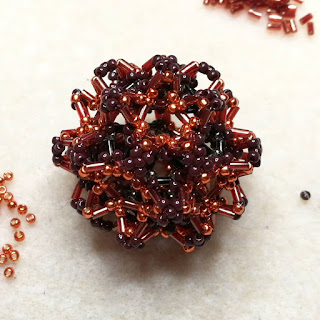
Meet Crater Moon.
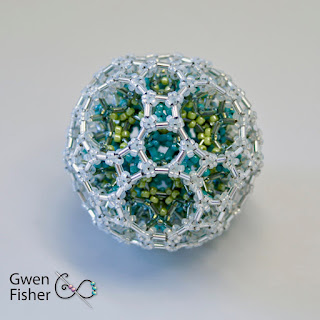
and Crater Moon in White...
https://www.etsy.com/listing/579082293
Each Crater Moon is composed of nearly 2700 beads.
https://www.etsy.com/listing/582628369/
The American Mathematical Society recently posted a photo of an amazing structure on their Facebook page with no comment of who made it. They called it a rhombicosidodecahedron (3.4.5.4) because that is the name of the polyhedron in the very inside layer, but Susan Goldstine noticed that the outside layer is actually a truncated icosadodecahedron (4.6.10). This object is a multilayered compound of unusual polyhedra.
With help from Susan, I figured out how to weave it with seed beads and thread. Susan built this model below using Zometool, and wrote, "This is what the structure above each triangular face of the rhombicosadodecahedron looks like. I feel better about not being able to make out what's going on from the original photo. The cavity has a triangle, six trapezoids, three pentagons, and the hexagon at the top." Furthermore, "Above each core pentagon is half an icosidodecahedron (3.5.3.5)."
To bead it, I used an edge-and-cover weave with 3 mm bugle beads for the edge beads and size 11° seed beads for the cover beads. (There's one exception, where I used 11° seed beads for the short edge beads under the squares.) In other words, every n-gon has 2n beads, including n edge beads alternated with n cover beads, all sewn in a loop.

Here you can see how I started to weave the inside layer, showing the edge-and-cover weave for (3.4.5.4), also known as the rhombicosadodecahedron as I mentioned above.
This is a photo from Ivona Suchmannova of Spiral Beading, showing the first layer curled into a ball.
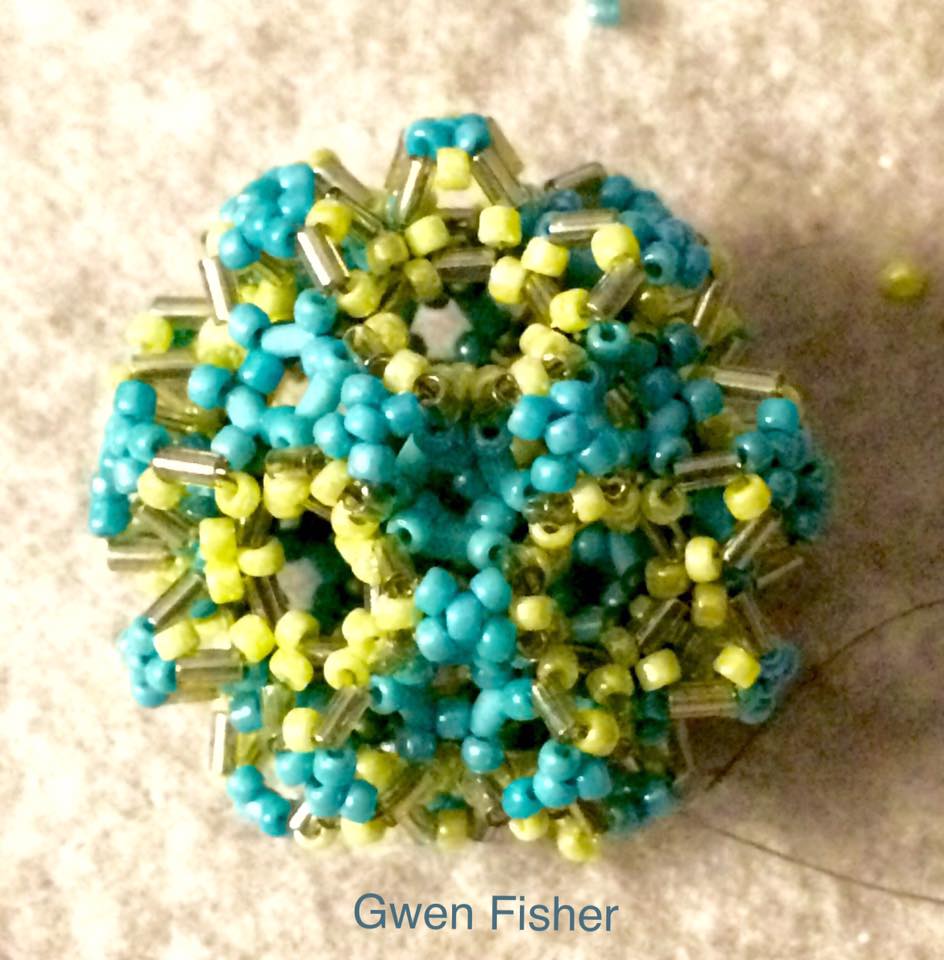
This is the complete first layer of Crater Moon with 6 mm bugle beads and 11º seed beads. This piece will finish a lot larger than the others because the bugle beads are longer.
Here is the start of the second layer on Ivona's bead. She stitched loops of triangles around the pentagons, connected by at the bugle beads.
This shows the start of layer 2 with the longer, 6 mm bugles. You can see the 5 triangles around the pentagons and the 3 trapezoids around the triangles. The short edge of the trapezoids is the aqua 8°. All other beads are 11° and 6 mm.
 
Next, the center front is still just one layer, 
but layer 2 is nearly complete.  Layer 2 
consists of 30 little 3D pentahedrons sitting 
on top of the squares in the first layer. Four 
little walls like a camping tent, the four other 
sides of the pentahedrons include two 
triangles and two trapezoids. The short sides 
of the trapezoids are the one place where 
we use an 11° instead of a bugle bead.


These show the second layer finished. The seed beads in the center of the Xs (aqua below, burgundy above) are the tops of the tents, the one place I used seed beads for edge beads.
This is the start of the third layer. It's triangles and pentagons. Here are the pentagons.
And here you can see both pentagons and triangles.
You can add the pentagons and triangle in two steps, or you can stitch them together.
Here you see 3 of the 12 rings done.

Four more to go!
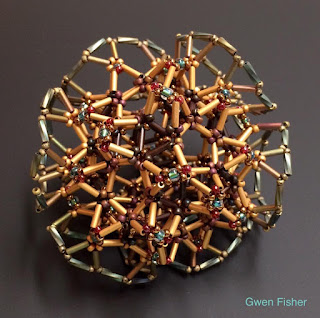
 Here all 12 are done.
In the fourth layer, I finished the space under the 30 squares, adding two trapezoid loops per square.

The fifth and final layer requires adding 720 size 15° seed beads to the outer surface.  Only then does the Crater Moon really hold its shape neatly.
You should make one.
It's just 11°, 15°, Toho 3 mm bugles, and Fireline 6lb.
And a whole lot of stitches.
Here you can see how big it is, just 1.75 inches across or 45 mm.
If you would like to have your very own Crater Moon, you can find the white one in my Etsy shop here: https://www.etsy.com/listing/579082293/
The larger Crater Moon is available here: https://www.etsy.com/listing/582628369/
Thanks for looking.
P.S. If you'd like to try weaving beads, but you think that the Crater Moon is a little beyond your skill set, have a look in my Etsy shop for tons of other tutorials for all skill levels.
Tuesday, February 9, 2016

Tila Icosahedron Beaded Beads Necklace with Nuts and Washers in Blues with Lampwork Glass

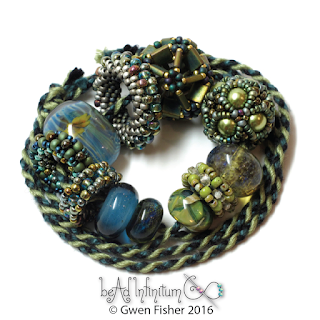
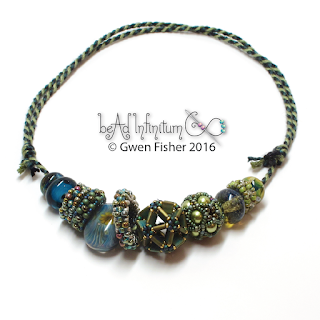
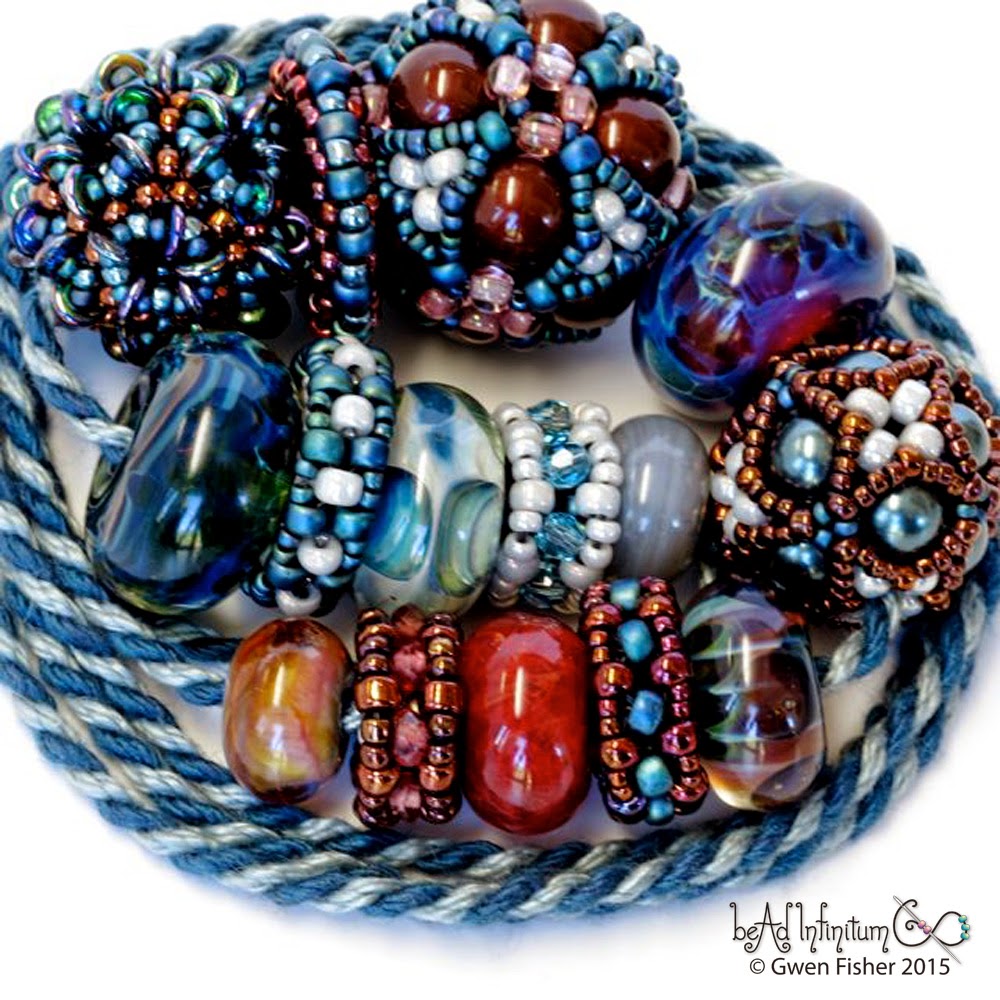
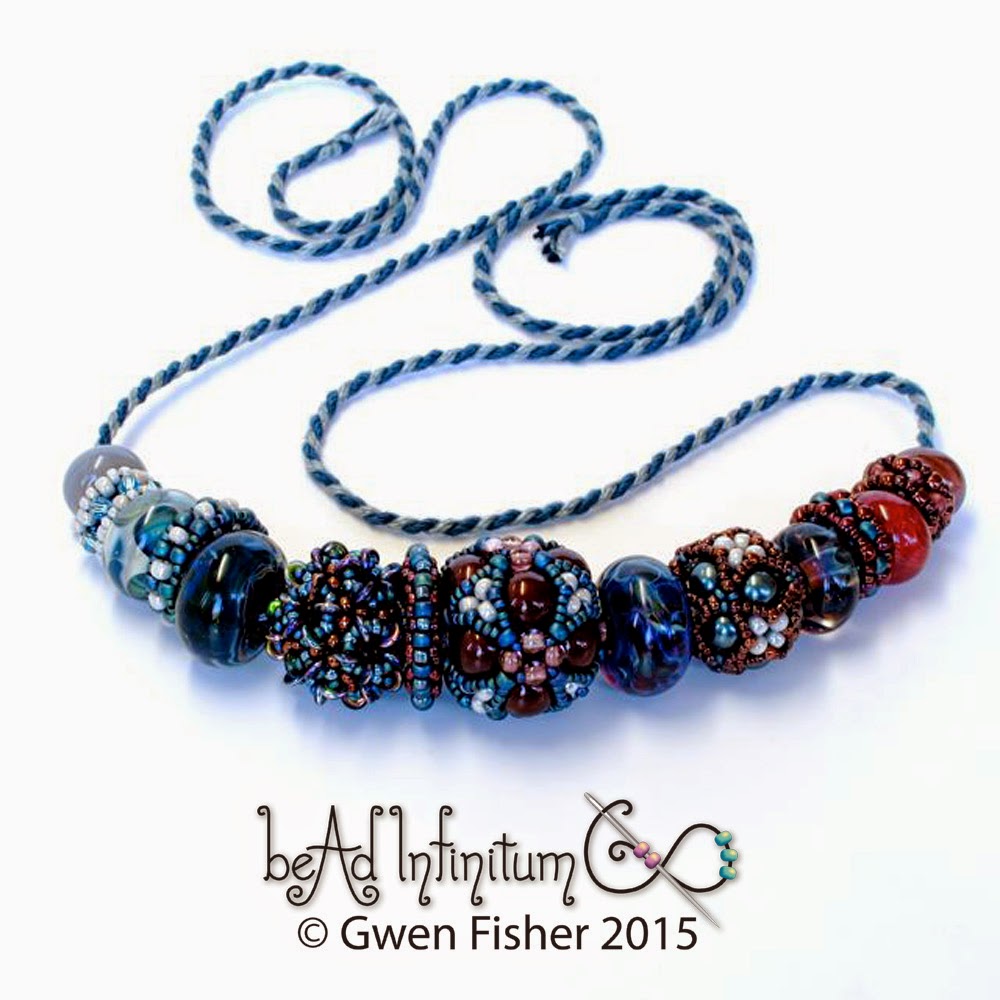
For this whimsical necklace, I made 6 beaded beads, including 4 Nuts and Washers and a Tila Icosahedron and an Octahedral Cluster. Then, I added 5 borosilicate and lampwork glass beads torched by 5 different artists. Together they make a pallet of blues and silvery greens. This is an unusual and strand of beads, eclectic yet harmonious, and never to be repeated.
Beaded Bead Necklace
They're all strung on a 26 inch piece of silk and cotton cord, that I twisted and plied on my spinning wheel in colors that match the beads. I tied sliding knots so you can adjust the necklace to wear it long or short. Alternately, You could use this set as a beginning of a more elaborate necklace, but I would wear them just as they are, strung on cord.

Beaded Bead Necklace
 Includes 4 inches (10 cm) of beads. Largest beaded bead (the doughnut) measures an inch (25 mm).
Beaded Bead Necklace
Thanks for looking!

Tuesday, February 2, 2016

New Tutorial Tila Icosahedron Beaded Beads in Three Sizes

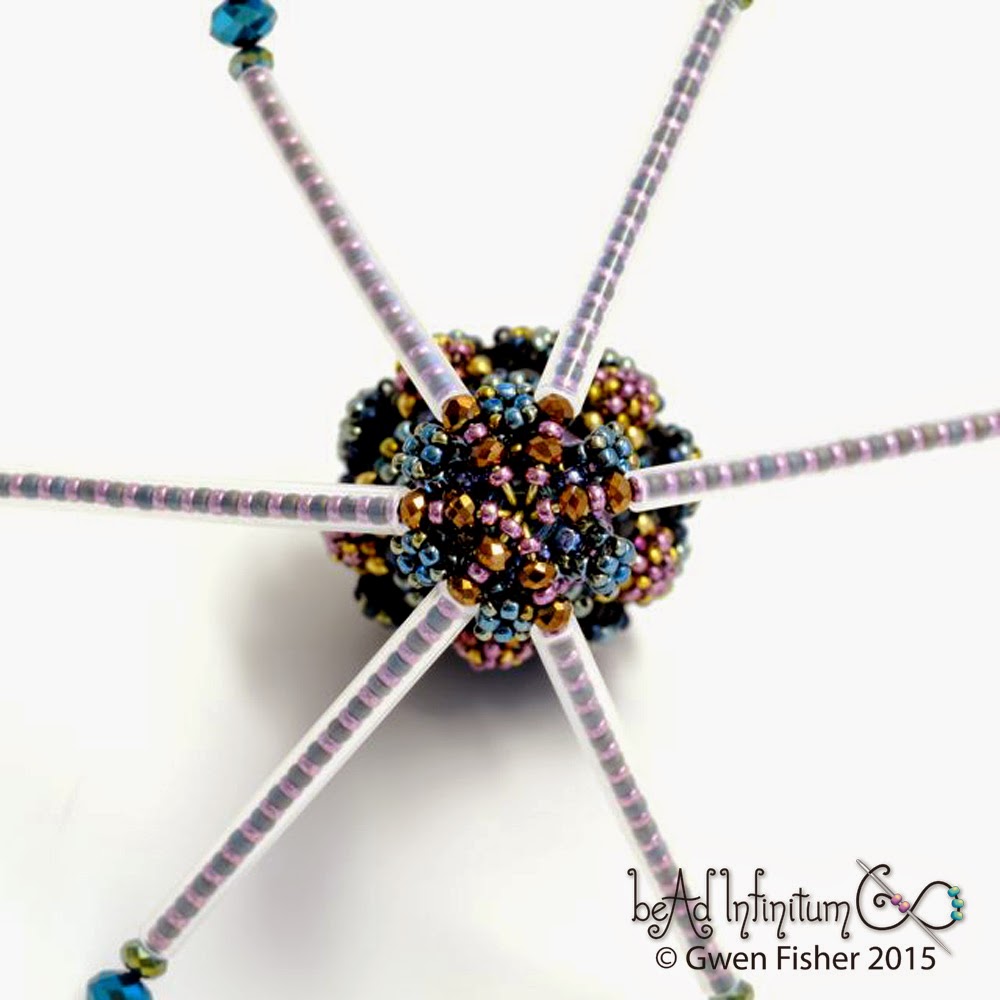
I finished a new beading tutorial that will show you how to weave beautifully spherical beaded beads with just two-holed beads and seed beads. That's it.  Use half Tila beads to make a 16 mm beaded bead (perfect for earrings!), Tila beads for 22 mm beaded beads, and both types for 30 mm beaded beads. These beaded beads are remarkably hollow with large holes let you see inside and through them.

Tila Icosahedron Beaded Bead
This tutorial is suitable for intermediate bead weavers who are comfortable with right angle weave. This beaded bead is a relatively quick project that will push your spatial reasoning thinking to new places. Presented is an easy and intuitive method for beading the beaded beads in all 3 sizes. The beads you need are just Tilas and two sizes of Japanese seed beads.

Tila Icosahedron Beaded Bead
The tutorial is 16 pages, including 90 illustrations and photographs. The tutorial is a PDF file that gives photos, illustrations and detailed written instructions to make the beaded beads in three sizes. Lots of tips are included. Several pages show detailed photos of all three sizes of the beaded beads in different colors and from different angles. One page gives information on icosahedrons and how they relate to this design. Two pages show beaded bead necklaces that include Tila Icosahedron Beaded Beads. Thanks for looking!

Wednesday, April 15, 2015

Coxeter Beaded Bead in Aqua

Here's the latest piece of my bead mat, a Coxeter Bead. It's a little over an inch wide, quite hollow, and it has big holes for stringing it on cord. The symmetry of this piece makes me think of a virus.
The dominant color is the aqua bugles, and then I added matte blue half tila beads to soften the bright aqua.  The tiny drop beads inside the circles came from a mixed box of beads, and I separated the colors when I wove them into the beaded bead. 
If you'd like to learn to make your own, you're in luck because I wrote a tutorial that explains how to weave a Coxeter Bead.  Thanks for looking!

Friday, February 6, 2015

T4 Bacteriophage Art Object in Beads No.2

A few weeks ago, I showed you my first beaded bacteriophage.  In the process of beading it, I learned that there were many more details known about the structure of the T4 bacteriophage than what I built.  So of course, I had to make another one with more details, bigger and better than the first.  Here you can see the two of them together.
The most significant difference between these two art objects is the capsid, or head. (Click on the photos to enlarge them.)
The first phage includes 12 pentagons and 30 hexagons.  It turns out that 30 isn't nearly enough.  So, the second phage shows 12 pentagons and 155 hexagons, making it more representative of real T4 phages as far as I understand it.  There seems to be some debate over the precise arrangement of the hexagons, but I think this is the most recent understanding of the structure. (Correct me if I'm wrong!)  This capsid has about 3500 beads in it, just in case you were wondering. 
For the first phage, I made the sheath like a tube of stacked rings (of beads) because I didn't realize the sheath is actually a spiral.  So, for the second phage, I used a beaded spiral tube instead.  It's not quite the same type of spiral as on a real phage because I opted for artistic aesthetics over scientific accuracy.  Sometimes I worried a bit about these adjustments, but I kept reminding myself that no matter how accurate my representation of a virus, it still wont work.  Like, it's never going to be able to infect a bacteria.  You'd be surprised how many times I had to remind myself...
The second phage also has a  more accurate collar shape with whiskers on its collar. Here you can see how big it is.  The legs are quite springy.
The second phage also has a more elaborate base plate than the first with little fibers that hang down, as if it's getting ready to make its move and insert its DNA into its host bacterium. 
Both of these art objects are for sale in my Etsy shop, gwenbeads.
Small Bacteriophage (No. 1)
Large Bacteriophage (No. 2)


I always enjoy a good beading challenge.  So, I'd like to thank Dr. Mark O. Martin for encouraging me to bead a bacteriophage.  I really knew nothing about these things before he shared a picture with me.  In beading these pieces, I learned lots of fascinating facts about viruses and microbes, but one of the weirdest is about color and electron microscopes. It turns out that electron microscopes take pictures with electrons instead of light.  This way, they can "see" things that are much smaller than visible light waves, like a thousand times smaller!  Think about that... visible light waves are WAY too big to capture images of these viruses.  These virues are TOO SMALL FOR COLOR!  Chew on that.  A consequence of this is that electron micrographs never have natural color.  When you see color images, they are always colored after the fact by people (possibly with the help of a computer). 

In other beading news, I also made a Twisty Bits Necklace.  Ever since I finished writing the Twisty Bits Tutorial, I've been wanting to make this necklace in these colors, mixed metals with gold as the feature.
https://www.etsy.com/listing/221506539/
So here it is, a long beaded bead on a yard of silk cord.  It's for sale.  Click the photos to go to the listing.  Thanks for looking.
https://www.etsy.com/listing/21506539/

Monday, January 19, 2015

Marsala Beaded Bead Necklace

This necklace features Pantone's 2015 Color of the Year, Marsala with aquamarine blue and titanium gray.
beaded beads
It includes 8 beaded beads: 5 Nuts & Washers, a Cube Cluster, an Octahedral Cluster, and a Conway Bead. I carefully selected 7 lampwork glass beads to make the strand into an asymmetric, yet perfectly balanced strand of beads. That's 15 beads in all. Together they make a pallet that is rich and earthy, sophisticated, and oh-so in fashion.
Marsala

They're all strung on a yard of blue cord of pure silk that I twisted and plied on my spinning wheel.
beaded beads
It includes almost 6 inches (15 cm) of beads. Largest beaded bead measures almost an inch (23 mm).  Thanks for looking!

Tuesday, January 13, 2015

Bacteriophage in Beads for the Microbiologist Nerd in You

bacteriophage
This beaded object represents a bacteriophage, a type of virus that infects and replicates within a bacterium. It contains a head (capsid), collar, sheath, tail fibers and base plate. This was one of the many images I worked from of a bacteriophage.

My favorite part of this virus is the elongated icosahedral structure of the capsid, exhibiting a tessellation of pentagons and hexagons for the capsomeres.
phage
For years, people have been telling me that some of my beaded beads look like viruses, so with a push from Dr. Mark O. Martin, I finally decided to bead something that really looks like a virus.
https://www.etsy.com/listing/218387471/
This piece measures about 6 inches high and 7 inches across. It's signed on one foot with my custom stamped gold filled tag.
https://www.etsy.com/listing/218387471/
It's made with glass beads, plastic tubes, wire and thread.  The head is hollow and is stiff yet flexible. This model has loops at the end of each leg so you could mount it on a wall. The legs contain wire, which are flexible.
bacteriophage
This is original art. This is also an educational model. Think of it as a tactile mind game, a little bit of sparkle to entertain your brain. If you would like to take it home, it's for sale here.   You can also see an even bigger and more detailed T4 bacteriophage in beads.  They are great gifts for the biologist who has everything because they almost certainly don't have one of these.  Thanks for looking.
Related Posts Plugin for WordPress, Blogger...