Friday, November 15, 2013

Lace Medallions: Part 4 of the Beaded Lace Adventure

I finished my first beaded lace necklace, and I'm so in love. 
Steampunk Lace Necklace
It's so comfortable, and it hangs beautifully below my neck. The drape is just perfect. I chose steampunk colors of black, gold, bronze and pearl.   
Steampunk Beaded Lace Necklace

You might notice this necklace features a large golden bronze Beaded Lace Medallion, which happens to be Part 4 of my Beaded Lace Adventure. The medallion tutorial is now available if you would like to make some medallions too.
The instructions explain how to make 5 different medallion variations. I give specific patterns for medallions with 6, 7, and 8 petals that range in size from 1 1/2 to 2 inches. The last three pages includes photos of several design possibilities for necklaces and wide cuff bracelets using medallions, flowers, and swags. more designs are coming!  Here's an example of a cuff design.
You can read more about the Beaded Lace Adventure here on my blog, find the patterns in the tutorials section of my Etsy shop, and please look out for more soon. I've got more designs in my notebook still to realize in seed beads, but I have to sit down and bead them first before I can show you.  So, come back later!  And as always, thanks for looking.

Saturday, November 9, 2013

Beaded Swags: Part 3 of the Beaded Lace Adventure


I'm still having fun designing lace for my Beaded Lace Adventure.  I love lace, always have.  And with more elements to design with, I can create larger, more elaborate compositions. 
Beaded Lace Adventure
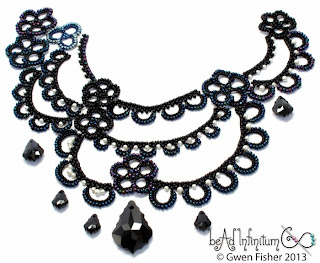
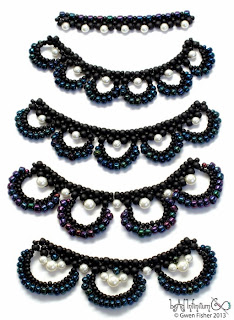
In my new pattern on Beaded Lace Swags, I show how to weave 9 different versions of swags, including these.  So you can make a beaded lace necklace with me!
Beaded Lace Swags
The compositions here also include Beaded Lace Flowers and Swarovski crystals.  This composition is almost symmetric, but I realized that if I want to make a symmetric necklace, I better start making two of each sample piece.  
 Beaded Lace Necklace
I did that for most of the flowers, but I haven't started making doubles of the swags yet. So these compositions are quite asymmetric, because that's all I've got.

Beaded Lace Necklace
You can read more about the Beaded Lace Adventure here on my blog, and please look out for more soon.  I haven't finished this necklace yet, and I've got more designs in my head, but I have to sit down and bead them first before I can show you.  So, come back later!  And as always, thanks for looking.

Wednesday, November 6, 2013

Behold the power of the BEADS!

I'm working diligently on my next installment of my beaded lace adventure, but until then, here's a little something to appeal to the 4-year old in you.

Wednesday, October 30, 2013

Going on a Beaded Lace Adventure

I'm going on a lace adventure.  Do you want to come along with me?
Beaded Lace Flowers
Let me explain...  For the last couple of weeks, I started beading lace.  I'm taking my inspiration from the fantastic Terese de Dillmont, who documented the art of Irish lace crochet in her Encyclopedia of Needlework, in the 1880s.  From Terese, I learned how to do crochet lace flowers, and I made a few free video tutorials that you can find here on my blog.  One classic crochet design is the basic five petaled flower.
Crocheted Flower

I tried to make a flower with beads and a needle instead of yarn and a crochet hook.  And so I did, and I made more and more, and now I have a little garden of black lace flowers made out of seed beads and thread.  
Beaded Lace Flowers
I have enough flowers to make a bracelet.   I could sew them together and add a clasp, but what I really want to do is make is a big black lace necklace, a collar that fits comfortably around the base of my neck with crystals hanging off of it and pearls connecting it together.  Something dramatic and Gothic.   So I just put in an order for the bigger beads, and I'm going to make more flowers.  I'm also going to add swags and other do-dads and lacy bits to fill out the piece until it's big and complicated.  And I want you to make one too!  Don't you want to make your own?  I mean, you like lace too, right?

Now, what's so great about this lace technique made with bead weaving is that it's easy to do, and because it's flat, it's easy to draw patterns explaining how to do it, and I think that should make it easy to learn as well.  So I'm writing a series of tutorials in hopes that some of you will play along and make beaded lace jewelry with me.  Athena's Acanthus Bracelet is the first design in the series.
Athena's Acanthus Bracelet
So I'm going to make big necklaces.  Rather than making one large tutorial explaining how to make a whole necklace, I'm going to write several shorter (read that "inexpensive") tutorials that each explain one kind of design. Rather than focusing on making complete jewelry, for now at least, I want to teach you how to make individual motifs, and show you ways of arranging them.  The result will be a series of designs and tutorials that all coordinate so you can compose larger pieces of jewelry.  I'm not sure how many of these tutorials I have in me, and it might depend upon how enthusiastic you gals are in encouraging me to make more.  But I think I have at least a couple more.  
So, I'm selling these as short tutorials, individually priced so you can just buy the parts you want to learn and make.  And I am pricing them at a fraction of what I normally charge to encourage you to try it out, and make your own beaded lace jewelry.

Part 1 of the Beaded Lace Adventure is Athena’s Acanthus Bracelet.
Athena's Acanthus Bracelet
Part 2 is Beaded Lace Flowers.
Beaded Lace Flowers
Part 3 is Beaded Lace Swags.
Beaded Lace Swags

Part 4 is Beaded Lace Medallions.
Beaded Lace Medallions
Part 5 is the Eucalyptus Leaves, which shows how to make a bracelet
Eucalyptus Leaves Beaded Lace Bracelet Tutorial
and the Eucalyptus Clover, a four-petaled design that plays well with the other lace motifs in this adventure. It's like the four-petaled flower from Part 2, but bigger.  A bunch of them in a row makes a nice band.
and more designs are coming! Look for in the tutorials section of my Etsy shop.  Here is my first complete necklace, made with motifs from Parts 2, 3, and 4.   
Steampunk Beaded Lace Necklace
Stay tuned for more because there's definitely more.  More tutorials and more jewelry.  As always, thanks for looking.

Monday, October 28, 2013

TUTORIAL Athena's Acanthus Bracelet

Late last night I finished a new tutorial.  I'm calling it Athena's Acanthus Bracelet because Athena was the Greek god of mathematics, and this piece looks a bit like one of those wreaths that they used to crown Olympians with, even if they were laurel or olive, instead of acanthus.
Athena’s Acanthus Bracelet is a flat bead woven bracelet that resembles a vine or wreath. The stitch is herringbone with two columns of beads. Using two sizes of beads in the herringbone makes the stitch curve into leaf shapes. To make a clasp, add a button on one end, and a large leaf on the other end for the loop. The button clasp is easy to do and undo, but is also secure. With a bit of string you can easily move the button to adjust the fit. This pattern is suitable for advanced beginner to intermediate bead weavers. Some basic knowledge of bead weaving is helpful.

The tutorial is 9 pages, including 40 illustrations and photographs. The tutorial is an instant download PDF file that gives step-by-step instructions for the bracelet in the photos. The last page includes photos and a discussion of a few variations.

This tutorial is part 1 of my Beaded Lace Adventure, where I aspire to write a series of tutorials designed around making a large collar necklace out of beaded lace. I am carefully documenting my process in this series, and I invite you to make a lace collar with me.

Saturday, October 26, 2013

New Bracelet Needs a Name

I'm working on a new beaded bracelet pattern, inspired by Irish lace crochet. 

I'm having a lick of a time trying to think of a good name for it.  Got any thoughts?

This pattern is now available: Athena's Acanthus Bracelet Tutorial

Wednesday, October 23, 2013

Beaded Super Right Angle Weave Quilt for a Group of Order 18

Here's my latest piece, a quilted wall hanging. The fabric is pieced cotton and silk, and appliqued with bead work. I call it, "Super Right Angle Weave: 18 Patches in 3 Colors and 3 Sizes" because I'm not very creative with titles. Florence suggested I call it "RAW Diamonds," which I like.  So that's it's artsy name. The whole piece measures 13 inches on a side. This quilt was included in Juried Exhibit accompanying the 2014 AMS Special Session on Mathematics and Mathematics Education in Fiber Arts at the Joint Mathematics Meeting in Baltimore, MD. It will be at the Ohio State Mansfield’s Pearl Conard Art Gallery from Monday, November 9 to Tuesday, December 8, 2015 in the Math & Art exhibition, "In the Realm of Forms." This quilt was also featured on the Scientific American website. This piece is SOLD
This piece began as a study in color for what I call Super Right Angle Weave (SRAW), a bead weave based upon the regular tiling by squares. Each beaded patch is 6 square by 6 squares of the tiling.  I weave loops of four beads in each square face and attach these loops across the edges of the tiling with a single bead between the loops.  For this set, I use a coloring with three bead types (two types for the faces and one type for the edges).  I chose three colors in each of  three sizes (albeit the purple beads are slightly different shades of purple across the three sizes), for a total of nine different bead types.  This set of 18 patches answers the following question: What are all of the possibilities if I weave SRAW with three colors, one color in each of three sizes, where the colors are arranged as shown?  The patches are arranged in sets of three, where each row uses the same three bead types, but arranged differently.  Here you can see it as a work in progress before I picked out the fabrics. (You can click on the photos to make them bigger.)

When I found the fabrics that matched the beads, I was delighted.  Each little square of bead work measures about 1 1/8 inches square. Here's a close-up of the beadwork. 
At some point, I realized my little patches formed a nice mathematical set.  When I arranged them in different ways, I found that the columns had things in common, as did all of the diagonals.  They formed sets in the sense that you could pick an attribute, and all three in the set were either the same on that attribute or all different.  It's like that game of Set, but my set has 18 cards instead of 81.  At some point, I realized I had a group of order 18.  Each element in the group corresponds to one patch of beading, up to automorphisms.  This group has two complete copies of 9 elements.  Within each set of 9, you can partition them into cosets vertically, horizontally, and along both diagonals. In other words, my arrangement shows different ways to build cosets with 3 elements in each coset (6 cosets * 3 elements =18). But if you group cosets across the two sets of 9, you only get 2 elements in each coset (9 cosets * 2 elements =18). 

A quick Google search told me there are 5 different groups with 18 elements, but I had no idea which one I found.

Lucky for me, mathematician Tom Davis was kind enough to help me identify which group of 18 elements this is.  After a few highly detailed emails, he concluded that it's the generalized dihedral group for E9.   Here's his argument:

I identified each patch with something like this...
Let me call the three colors Yellow, Green and Blue (Y, B, G), and the position attributes of say, the bottom point: yellow, green, blue (ygb).

Then each pattern can be classified by a 6-character code, like this:

(tuv)
(wxy)

Where t=largest, u = medium, v = small
and
w = bottom, x = left corner, y = other


Fore example,
(YGB)
(bgy)


distinguishes the size and position attributes.

Now, if we consider, say, (YGB) and (ygb) to be the "correct" order of the beads in both categories, then I can treat both the top and bottom parts of the pattern representation as a permutation away from the "correct" patterns. I can combine them into a single permutation, like (YBG)(gyb) or (BG)(gy) where you never mix the capital letters with the lower-case ones since size and position are independent.

Then your group operation is trivial: it's just the multiplication of the permutations, and (using Mathematica) I found that the total group size is, in fact, 18. (In other words, none of the multiplications take you outside of the patches you've made.)

So you CAN consider them to be group elements, but depending on which of them you chose to be the identity, the operation table would be different. I had Mathematica make a group operation table, but it translated the elements into numbers and here it is included as a screen snap.

It's clearly not commutative and it's not the dihedral group, so it's either the direct product of S3 and Z3 or the "generalized dihedral group for E9" whatever in the heck that is :)

I don't think it's S3xZ3. I've also included the screen snap for that (it's the one with the group named "dp" (but it could be: I'm not so good at comparing tables where the elements aren't necessarily listed in the same order).
In fact, it IS the "generalized dihedral group for E9." Here's proof. I had Mathematica draw the Cayley graphs of your group and of S3xZ3 (called "dp") and they're completely different. Included is a screen snap of the Mathematica result:
Now let's give Tom Davis a big round of applause.  Thanks Tom! 
Related Posts Plugin for WordPress, Blogger...