These beaded, sparkling, spiraling slugs are very twisted and sensuous. It's
hard to capture their beauty in a single photo.
You see?
What could be more romantic than two slugs in love?
How about three slugs in love? See the three slugs on the left in gold, orange and red? I call this one Slug Fest with a little slug earring for the dangle.
I was inspired by the colors of lava. To me, it looks like frozen flame. All of the variations shown above are patterned and explained in my newest beading tutorial, Slugs in Love. I even give a recipe for a five (5) Slug Fest in the tutorial, if you are so adventurous to try it. I haven't made one yet. It's a lot of beads.
These beaded slugs are super fun to make, to watch them spiral a little more, as you make each
stitch. I really hope someone makes the five slug version, just so I can see a photo of it.
If you're wondering why I call this Slugs in Love, you should watch this video on the mating behavior of slugs.
And this one with snails. It's totally worth two minutes.
Anyway... The technique I use for my beaded slugs isn't original. I learned about it after Pamm Horbit showed me some of her pieces including, "Max's Not a Knot," here. This
piece is actually a lidded box - the lid comes off. It placed 2nd in
the accessories and objects division of Bead Dreams 2012.
You see, last Fall, I spoke to the Northwest Bead Society in Washington State, and Pamm attended my lecture and took my classes. She had a big box of these twisted balls, cubes, and other highly symmetric pieces of beadwork that she made, using all sorts of different point group symmetries, especially chiral ones. They ranged in size from tennis balls to softballs. Each one was more spectacular than the next, all twisting and sinuous. Pamm had found a basic beaded unit in photos on line, and from there, she figured out how she could make lots of repeats and assemble them in lots and LOTS of different ways. Her collection was quite diverse and impressive. I could scarcely see out how she did it. But she was patient with me as I tried to figure out what I was holding in my hand as it glistened under the lights. She explained the essence of the idea, and even was kind enough to give me a couple of triangles that are beaded with this technique. It turns out it's based on the peyote stitched triangles (google it!), but the ones Pamm gave me used different sizes of beads to make them spiral, like the Celline spiral, made popular by Susan Golden, when she published the Cellini spiral bracelet in the Art and Elegance of Beadweaving in 2003. Here's the Cellini spiral I made in 2005 with Golden's directions. I never finished it. It's a half bracelet, unwearable, but I like that you can see inside the spiral.
What Pamm showed me is that you can apply this same technique to beaded triangles. So I beaded this green triangle using the samples Pamm gave me.
But, I didn't finish the back correctly. What can I say? It was my first one, and by the time I finished it, there was nobody there to tell me how to do it.
I played around with the idea by changing the symmetry, and came up with these earrings.
I made a pair for myself in purple, and I fell in love with this photo and the earrings. They are so tiny and dainty. Just a splash of color dripping from the ears.
I named them Archimedes' Teardrops because of it's relationship with the Archimedian spiral. To skip the math, please jump to the next paragraph now. An Archimedian (or arithmetic) spiral is the locus
of points corresponding to the locations over time of a point moving
away from a fixed point with a constant speed along a line which rotates
with constant angular velocity. The relationship with the beadwork is that you end up with a constant set of beads that is constantly repeated as you rotate around the fixed, central axis. I think that works. Anyway, I had to name it.
Then I made this piece that I didn't know what to do with. It's not a really beaded bead because it doesn't have an obvious hole. It's just a beaded thing, and a bit slug-like.
So I posed it with Batman. Behold the power of the BEADS!
Then, I illustrated, and wrote a complete tutorial for my little Teardrop earrings, and as I was releasing it, another bead designer pointed me to
June Huber's website, where she had a pattern for the same earrings. The only difference are that Huber used Delicas where I used size 15° seed beads and her hanging method is different. I even took this photo before I saw Huber's photo of nearly the same design in her earring tutorial. Hmm.
I surfed around Huber's website, and found that she did a lot with the technique of peyote stitch with herringbone increases, like this Arabesque cube. (Seriously, click on that, it's gorgeous). Shortly thereafter, I noticed that Cath Thomas also wrote a tutorial for the same earring and her variations: Pepper Fork and Yukka Flower.
That all happened last Fall. I made up something new that wasn't new at all. I was a little sad because I put so much work into it, but I knew I couldn't release a tutorial that someone else had written before me. It didn't matter that I made it up by myself. I hadn't made it up first. It wasn't mine to distribute.
But I really loved these spirals, and I wanted to design with the technique. So, I didn't toss out the tutorial completely. I just shelved it. I chalked it up to a learning experience. Since then, I've been trying to design a new variation, something
that is different enough and new enough that it wouldn't be copies of what the great beaders before me had already done.
So I reconsidered the symmetry. Where Huber, Horbit and Thomas all ADDED symmetry to their designs, Slugs in Love took it away.
I found a different unit of repeats, and then made it have a lot of different beads, big fat slugs instead of tiny, dainty ones.
If you're so inclined, you could take one of the basic units I patterned in Slugs in Love, make copies of it, and try to recreate Arabesque cubes, and other polyhedra and flowers, but bigger, much bigger. Warning: That's a lot of beads! And please, Please, PLEASE, I really can't stress this enough... Send me a photo if you try it! Thanks for looking.
We are continuing to get your patterns
relisted as PDF instant downloads at reduced prices. It's a slow process, but today we
got the Borromean Link patterns and kits back on the website.
This year, at Burning Man, a crew of 27 of my friends will be working together and with me to build a 24 foot tall genie bottle. This artwork made possible due to a grant from Burning Man.
The
Genie Bottle will attract travelers along their journeys with its inner glow
and the promise of wishes fulfilled. An Arabesque genie bottle evokes the twin
spirits of temptation and the fulfillment of wishes. For most of us travelers
found along the roads and trails of Burning Man, temptation is always at hand,
and the promise of wishes fulfilled propels us further along the road. This genie
bottle is a beacon to these travelers. Like a siren, it lures with a sensuous
promise of adventure and discovery. And temptation. When found, the bottle
provides a soft and cozy
protected space where wishes and aspirations can be incubated and called upon.
The Genie Bottle will be 24 feet tall
and 14 feet wide. It will be made
from plywood, bolted together with steel. The plywood will be laser cut with Arabesque designs. There will be two exits at the base,
and one through the top of the spout.
There will be a ladder down about half way from the top, and a pole to
slide down for the bottom half. Inside
will be a plush, round sofa, with pillows and fabric draped from the walls. It will be primarily lit from the
inside with strip LED lights.
Florence Turnour
and I have been working on redesigning our beAd Infinitum website for the last month,
giving it a new look, updating photos of our bead work, making it easier to navigate, and most significantly,
offering instant PDF downloads. Have a look!
This is the fourth time we have seriously remodeled our website since we started in 2005. The task of redoing a website like this is quite large. So, to keep our sanity, we are updating our pattern library in stages. We still have yet to re-list many of our patterns and kits, but we plan to get them all listed and available for purchase as soon as we can. Thank you for your patience.
Here are a couple of beaded honeycombs. In geometry, a honeycomb is a way to fill space with polyhedra, with no overlaps or gaps, like a tiling (tessellation), but in more than two dimensions. A beaded honeycomb is a 3D weave of a honeycomb, where (a) beads are placed on every edge of the honeycomb and (b) two beads are connected if they are on adjacent edges of the same polygonal face in the honeycomb. First is this tetrahedral-octahedral honeycomb I beaded in 2006, and it's remained one of my favorite beaded beads since then. Today, I finally got some better photos of it.
At the time, I made this, I knew that it represented some sort of crystal structure, and I knew there were at least a couple hundred different molecular arrangements of crystals. (In fact, there are 230 space groups.) I was a little overwhelmed by the possibilities at the time. So I shelved the idea of looking at them until lately. I recently beaded this bitruncated cubic honeycomb.
If you like this post, you'll certainly enjoy the beadedruncitruncated cubic honeycomb. I like to imagine that I'll find time to bead more of these honeycombs in the future, now that we have Wikipedia as a resource. If you have a favorite honeycomb that you want to see rendered in beads, let me know because I could really use some help picking. There's just so, so many to choose from! Anyway, thanks for looking.
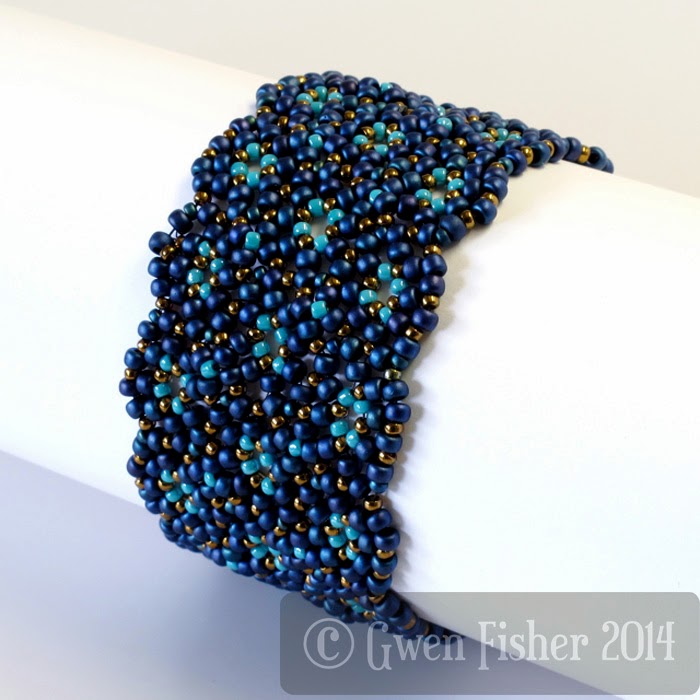
My newest tutorial explains how to weave the Lozenge Bracelet
with two sizes of seed beads and thread. The Lozenge weave creates a
thin fabric of seed beads that is flexible and comfortable. You can make this weave in lots of different shapes because
the pattern repeats like wallpaper.
Lozenge Bracelet with Beaded Button Loop Clasp
This tutorial also includes
step-by-step instructions for weaving the button loops. This clasp is
quite easy to do and undo, and it stays buttoned when you want it to. I wore the bracelet out to lunch, and I didn't have a single loop come undone. Plus,
if one were to come undone, there's two more to catch it. The reason
they work is a combination of the flatness of the loops and the shanks
on the buttons.
This lozenge pattern is an unusual and complex angle weave, making it suitable
for intermediate bead weavers who are already very comfortable with
right angle weave. If you like RAW and want a new challenge, you’ll
love this. If you want even more of a challenge, you can scale this weave down to use your itty bitty size 15 seed beads, like I did for this Lozenge Weave Chain Necklace.
This tutorial is 21 pages, including about 100
illustrations and photographs. The tutorial is a PDF file that gives
step-by-step instructions for the bracelet in the photos. The last 6
pages include photos and illustrations of a bunch of variations. Here you can see all 21 pages. If you purchase the tutorial, you get the exact same 21 pages, but in an instant download, LARGE, easy-to-read PDF file. Isn't life great?
 Today, I posted a new kit that makes a pendant and pair of earrings in all of the colors of the rainbow.
 I really love working with a rainbow palette. It's so bright and cheerful.
 Click on the photos to go to the listing.
 Thanks for looking!