Showing posts with label publication. Show all posts

Monday, July 6, 2015

Bridges Paper - Highly Unlikely Triangles and Other Impossible Figures in Bead Weaving

I have been going a little crazy saving a surprise for you all, and today is finally the day to share it!  Meet the Highly Unlikely Tetrahedron.
These are photos that I will be presenting with my paper at the Bridges Conference in Baltimore this month.
My paper is called, "Highly Unlikely Triangles and Other Impossible Figures in Bead Weaving." It is now available from the Bridges website. You can download the free PDF file here.  I hope you enjoy it!
Be sure to browse the entire collection of papers in the 2015 Proceedings of the Bridges Conference.  There are so many great contributors this year; it will be impossible to pick a favorite. Seriously, go brew yourself a pot of coffee, start at the beginning and click on any title that looks interesting. Candy for your brain. If you can make it to University of Baltimore on July 29 - August 1, 2015 (Wednesday - Saturday), you can even go to the Bridges Conference and listen to the authors talk about their papers, which is way more fun than reading them because you can meet the people who wrote the papers and ask them questions.
If you don't know about the Bridges Conference, neither did I until about 2003, when I heard a talk at the Joint Mathematics Meetings by Reza Sarhangi, a Bridges founder and generally fascinating fellow. Reza talked about this meeting where people discuss connections between mathematics, science and the arts, including visual art, architecture, music, poetry and theater.  As I listened, I thought, "I think I have found my people." It was a big moment for me, listening to Reza speak.  So, I went home and wrote a couple short papers on quilting and math, and submitted them for review.  Next thing I know, I was presenting my work to a group of like-minded people, other mathematical artists and mathematicians who loved art. They had many fascinating ideas to share, and they educated each other, plus they had interest in my work and opinions about it. I was in math-art-nerd heaven. I went to four Bridges conferences in so many years, and then I left academia to be an artist, and stopped going, and started going to Burning Man instead and doing art there with that community. Then, after last year with the Genie Bottle, I decided to take a year off of Burning Man, and go back to Bridges this year instead. So I wrote a paper on beading impossible figures, they accepted it, and I booked my tickets.

Then, Kelly Delp and the other organizers sent me an email. They thought my paper was so swell that they asked me to give a keynote address to the whole conference.  That means that I get more time to talk and show slides, and there will be no other concurrent sessions while I will be speaking.  I also get a little spot on their website here among the other keynote speakers, including John H. Conway, Ingrid Daubechies, and Alan C. Kay, who all have their own Wikipedia pages, by the way. So, you get that I'm excited to go and see and meet all the people. They asked me to make a mosaic for their website, which you can see here. 
The mosaic includes photos of our jungle gym Bat Country and the Genie Bottle, two Burning Man art projects that I created with the help of my friends in Struggletent.  The beadwork includes a circular Celtic knot, my cover of the Journal of Mathematics and the Arts with an Octahedral Cluster and a Seirpinski tetrahedron, bacteriophages, DNA, a Highly Unlikely tetrahedron from my Bridges paper, and a few photos of cellular automata, which is the project I'm currently working on.  So stay tuned for that. It's going to be cool. You'll like it.  I promise.

I hope to see you in Baltimore!  As always, thanks for looking.

Thursday, May 29, 2014

Genie Bottle Update 2

The Genie Bottle, a Burning Man Honorarium Art Project is progressing. Marty Kenny designed all of the cutouts to be cut into the wood, and Paul Brown inserted them into this Solidworks rendering. If you click on the photo, you can see we also added some of our favorite math equations to be cut out of the wood. In the spirit of Arabesque art, we wanted to add some "calligraphy" and in the spirit of genie magic, what's more magical than beautiful mathematics? The math IS the genie!
Using Paul's computer model, Christy Burback and I made a little scale model out of card stock and tape.  It's about 1/18 of actual size. We cut out and traced the pieces using the specs from Paul Brown's design.  Here you can see Christy with her arm up inside the bottle.

While I am the lead artist on the Genie Bottle, for most of the tasks for designing the Genie Bottle, I've delegated them to other crew members.  I've been leading the designers and engineers towards a particular aesthetic for the overall piece, but like the cutouts for the wood and the lighting, other member of Struggletent are leading the efforts to design and build individual components.  The finished Genie Bottle and its burn will truly be the work of a group of people, my campmates of Struggletent.

The one component I'm designing are the tassels, although I won't build them all myself.  Fortunately, we have lots of helping hands.    My vision is to have a set of 10 large tassels and cording to hang inside the bottle for decoration.  This is my drawing for how I want them to look, more or less.  I haven't decided what color to paint the finials yet.
This is some of the wool we will be using.  This is about a pound of wool.  You can also see the wooden finial that Mike Ryan made for me.  It's got a hole drilled in the center, meaning it's a giant bead. Painted wooden finials like this will top each tassel, effectively turning them each into a big bushy mop with a handle.
Making these tassels requires dying a lot of wool, over 7 pounds of soft springy Merino. (In two dye pots, I can dye 3/4 of a pound at a time; so it's taking me days and days to dye it all!)  This is what the purple wool looks like in the dye pot before the dye has soaked in.

Finial Master Mike Ryan also did a practice burn of the bottle last week at a camp out.  You can watch the video of the burn here: https://www.youtube.com/watch?v=7qr6W50dggg
A structure like this will fit inside of the Genie Bottle and will be built inside of it on burn night, tentatively scheduled for Friday at Midnight.  "It is designed to be an anaerobic burn and has minimal oxygen, That's how the smoke is developed. Once a heat source reached a stoichometric point, it ignited."  That's why it shoots fire out the top.

While we're on Burning Man art, I thought I'd share some updates about Bat Country, our previous Burning Man Honorarium Art from 2008, 2009, and 2013.  First, we're published in The Washington Post this week in a slide show titled, "A New Way to Look at Math."  We're #7.

I also got some really nice photos from photographer George Post of Bat Country from 2013.
Here you can see the whole crew at the top as I hold up the very last ball to be attached at the apex.  THIS was a very exciting moment for me and the whole Struggletent crew, and I'm so pleased that George sent me a photo to commemorate it.
And here's a really stunning photo of Bat County and the Temple of Wholiness.
Thanks George Post.  And thank you for looking.
Here you can read Genie Bottle: Update 3.  Here you can see photos of the finished Genie Bottle at Burning Man.

Thursday, May 15, 2014

Bat Country in the Press

Yesterday, was a very good day.  You see, yesterday, my name and my art were published in The Guardian Online Newspaper.  Apparently, the newspaper's online edition is the third most widely read in the world.  Anyway, 50 Visions of Mathematics, and my art is one of the 50 photos in that book.  This book is published by Oxford University Press, which is the largest university press in the world, and the second-oldest.
The art of mine they published is Bat Country, the Sierpinski tetrahedron jungle gym that I created with Paul Brown and our Struggletent crew with help from Burning Man.  A big photo of Bat Country is in that book.  What's more, we're even on the cover!

Yup, my name and my Playa art are on The Gaurdian website, and on the cover of a OUP math book!

Yesterday was a very good day.

Sunday, July 8, 2012

Using tiling theory to generate angle weaves with beads

I am very excited to announce that our paper "Using tiling theory to generate angle weaves with beads (pdf)," coauthored with Blake Mellor, has been accepted for publication in the Journal of Mathematics and the Arts.  The acceptance was conditional on our making changes recommended by the reviewers.  The final, reviewed and edited version was published by the Journal, volume 6, issue 4, 2012.
Looking back at my notes, I started the first draft of this paper in July of 2009, and I started beading the designs in it in 2008.  It has been a long process writing this paper, drawing the illustrations, beading the samples, and taking photos, but I hope the ideas in it will inspire you the way they have inspired me. 
If you are still looking for the link to the draft paper, try the first one up at the top :) The third link will direct you to the edited version that was published. Thank you for looking, and thank you for your comments.

Tuesday, March 20, 2012

Cube Cluster Pattern


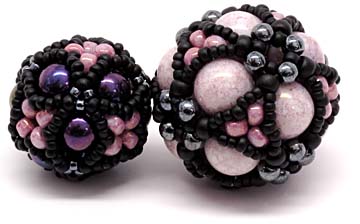
With the release of the 3-page, abridged version of the Cube Cluster Beaded Bead pattern (above right) in the current issue of Beadwork Magazine, we are now selling the full 14 page version of this pattern combined with our old favorite, the Octahedral Cluster (above left). You get two patterns for the price of one, 33 pages and 140 photos and illustrations in all. Included are lengthy discussions of basic beaded cubes and octahedrons so that even beginning beaders can follow along.
These two beaded beads make a great matched set, because they use the same weaving technique and have the same symmetry.  They are also both very round and in two complimentary sizes, with the Cube Cluster measuring a full inch, and the Octahedral Cluster at 3/4 inches.   And OF COURSE, our pattern has lots of variations and inspirations if you want to explore the technique further. The Cube Cluster also has a remarkable large hole, over 3mm, making it suitable to be strung on a cord or a thin chain. See the hole in the center of the blue and gold one below.

Friday, January 20, 2012

Tutorial -- Twisted Cubic Right Angle Weave

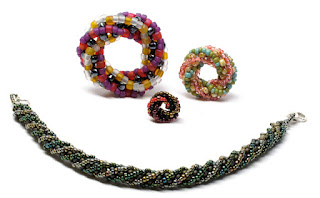
I just finsihed my newest tutorial on cubic right angle with a twist.  Twisted cubic right angle weave is a just like regular cubic right angle weave, but forms a twisted tube.  The twist in the stitch allows you to color it like a candy cane.  It is suitable for a cable on a necklace or bracelet.  You can also join the ends to make a small donut-shaped beaded bead, which is what I like to do with it because you get nifty torus knots and link designs on the surface of the donut. 

The pattern gives complete instructions for weaving the donut including the use of several sizes of seed beads and different numbers of repeats around the tube.  Of course, I had to make the smallest one I could since you know I'm a sucker for itty bitty beaded beads.  This one is just 13 mm across and 5 mm thick.

I end this post with some happy donuts, because donuts make me happy.  The smile is also a bracelet, because you can also make jewelry with twisted cubic right angle weave, you know, if you're into that sort of thing.


Tuesday, February 1, 2011

Journal of Mathematics and the Arts

JMA recently posted images of the covers of the journal.  You can see my beaded beads on the second issue, published in 2007.  This cover shows three views of an Octahedral Cluster and another three views of a beaded Sierpinski Tetrahedron, one of which is shown below.  If you would like to read the paper that goes with the cover, download a free copy of my paper on the symmetry of beaded beads (pdf).

Saturday, November 27, 2010

2011 Mathematical Art Gallery

A set of 12 of my beaded beads were selected for the 2011 Exhibition of Mathematical Art at this year's Joint Mathematics Meeting.  I call the set "Blue Ionic Polyhedra: 12 Beaded Beads in Two Sizes."
I wrote a pattern so that you can learn to weave own beaded Ionic Polyedra.  The pattern includes information on all of these (and other) beaded beads except the rhombic dodecahedron.

Friday, September 17, 2010

MAA Poster

Here's the poster announcing an upcoming meeting for the Mathematical Association of America.  It has my bead work on it.  The bracelet is the Night Sky weave, and the beaded bead is from my soon-to-be-released Ionic Polyhedra pattern.

Tuesday, February 16, 2010

Off to Wyoming

I'm off to Wyoming tomorrow to speak about how I use mathematics in my art, as well as how I use art to teach mathematics.  Here's the flier for my talks, workshops, and art exhibit. So if you're in Cheyenne, I hope you'll drop by.

Friday, September 11, 2009

Deco Lotus Earrings in Beadwork Magazine

I got my Deco Lotus Earrings published as a project in this current issue of Beadwork Magazine, Oct/Nov 2009. Check it out. Forgive me for taking the photo of these earrings before I attached the ear wires.


I also got my Harvest Jewels Necklace published on the back cover of the same issue in the Firemountain Gems advertisement. The center bead is a Time Machine Beaded Bead.  This necklace is sold.

Monday, August 3, 2009

Archemedes Star in Beadwork Magazine

I have a project article in the current issue of Beadwork Magazine, August/September 2009, Volume 12, Number 5. The project shows how to make an Archimedes Star weave bracelets with seed beads and some large disk beads or buttons.


Archimedes Star is one of many possible star weave designs. This particular
one uses stars with three points, joined in circles of 6 stars each. I named this particular weave after Archimedes because it looks like one of the Archimedian tilings with equilateral triangles and regular hexagons (3.6.3.6).
What I learned: I have found that an infinite number of different star weaves are possible. So I started writing a paper on the subject to document how I construct them. You can see my website for two more examples of star weaves including Kepler's Star and Night Sky.

Related Posts Plugin for WordPress, Blogger...