Monday, October 4, 2010

Earrings and Beaded Beads

I started weaving beads in 2004, and in that time I have made more jewelry and beaded beads than I remember.  I have sold and given away most of it, I think, but I have also been hoarding some pieces, not to wear, but just because I like looking at them in my bead box.  I am trying to get some of them listed in my Etsy shop and set them free.  Sometimes it's hard to let your art go, but I'm working on it.  Here are three new listings in my my Etsy shop.

Three Drop Earrings
I made this pair of Three Drop Earrings in 2006.  I wore them once, but I didn't like the earwires I used.  Today I exchanged the old ear wires to a pair I made more recently, and now they are finally done.
Mini Infinity Dodecahedra
I happened upon the Infinity Dodecahedron weave in 2005 as a result of studying the bead work of Laura Shea.  We met in 2004 at a Bridges conference in Banff, Canada. Laura was kind enough to allow me to take some photos of her beaded beads, and in her work, I recognized the potential of applying the mathematics of polyhedra to the art of bead weaving.  The Infinity Dodecahedron was a consequence of my seeing Laura's work.  I made these beaded beads in 2008.
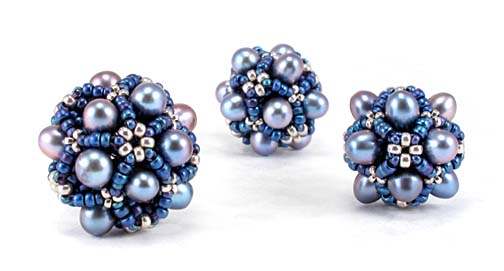
Mini Ionic Cube Earrings
These earrings are new as of last night.  These feature miniature Ionic Cubes in colors for fall.  I love the these color together, leaf and earth, the colors of the forest.  Nature makes good color schemes.

Sunday, October 3, 2010

Intersecting Links in Bead Weaving

Years ago, I'm not sure when, I learned about this configuration of three links is know as the Borromean rings (or Borromean link),  I remember drawing doodles of this three-dimensional shape when I got bored with my professor's lectures.
In 2005, I learned how to weave seed beads with box stitch (e.g., three-dimensional right angle weave), the link was a natural design for me to weave because I had drawn it so many times.  I made each rectangle with different colors of seed beads, but the rectangles are all the same size and shape, each measuring 27mm by 18mm by 7mm.

 I find the Borromean link is particularly interesting because all three links are collectively linked despite the fact that no two of them are linked to each other.  To emphasize this, I left the dark link open so that you can take the three rectangles apart and put them back together again. 

This piece was featured in my 2007 paper, "Three-dimensional finite point groups and the symmetry of beaded beads" (pdf) as and representation of the pyritohedral symmetry group Th. Personally, I remeber this symmetry type as "gift package" as I like to think of it as a the same symmetry as a cube box wrapped with 3 pieces of ribbon.  This Beaded Borromean Link is sold, but if you would like to learn how to make one for yourself, check out the pattern and kits for the beaded Borromean Links

Several years ago, I had the honor of hearing George Hart give a talk on Orderly Tangles.  He presented this talk at in Banff, Canada in 2005 at a math and art conference dedicted to H.S.M. Coxeter.  (Coxeter was a mathematician, particularly interested in geometry, whose work inspired the great mathematical graphic artists M.C. Escher in the 1950s.)  Five years later, I find that Hart's talk was one of the most memorable talks from that conference, at least for me it was.

Hart writes, "In the 1970s and 1980s Alan Holden described symmetric arrangements of linked polygons which he called regular polylinks and constructed many cardboard and stick models. The fundamental geometric idea of symmetrically rotating and translating the faces of a Platonic solid is applicable to both sculpture and puzzles." Listeneing to Hart's talk, I learned about new ways of linking polygons.  The result is this set of four linked equilateral triangles. Each triangle is a different shade of green, and they all have matching corners in shiny copper.


The design for the bead woven triangle was origianlly published by Phyllis Dintenfass in Beadwork magazine, in the Dec 08/Jan 09 issue.  It was republished in the special issue called, "Beadwork presents Favorite Bead Stitches" published July 2010.
Once I saw Dintentfass' triangle pattern, I knew immediately that I had to use it to make an orderly tangle.  I had been wanting to bead this tangle for a couple of years, and I was thrilled when I found the perfect bead weave to make it.  (It's been sitting in my seed bead box for a year and a half, and I finally got around to photographing it.)  The edge of each triangle is 42mm and the complete tangle measures 48mm at its longest.   This beaded link is sold.

Tuesday, September 28, 2010

Ionic Rhombic Dodecahedron and Cuboctahedron

Here is my latest beaded bead using my Ionic Polyhedra weave.  This one is based upon the rhombic dodecahedron.  It is 33 mm wide and composed of over 600 beads.  I am happy with the way it came out because it is reasonably stiff and very hollow.  Because it is so hollow and the holes are so large, my boyfriend says it looks like a geode.  I like the way you can see all the way through 4 different holes simultaniously.  The first photo shows this.

The second photo shows a different type of hole in this beaded bead. 
After I took these photos, I found another way to hold it that shows two holes.  In this view below, the large purple crystals in the back show through the holes in the front, falsely making the beaded bead appear solid.

The rhombic dodecahedron is the dual of the cuboctahedron.  Below I show the dual correspondence between these two polyhedra, using my Mini Ionic Polyhedra weave.    I tried to pose the pair of beaded beads so that little gold beads have the same configuration in each photo. 

The cuboctahedron is on the left and the rhombic dodecahedron is on the right. Because they are duals of one another, one has faces where the other has corners.  In terms of beaded beads, one has holes where the other has stars of seed beads. 
These two little beaded beads are just two centimeters wide, and they are each composed of exactly 288 beads.

Monday, September 27, 2010

Design Team Call for Seed Beaders

Are you a seed bead weaver?
Do you want to get free patterns from beAd Infinitum?
Do you want a this fancy banner to adorn your blog or website?
Florence and I just put out a call for talented seed beaders who would like to join our design team. Team members get free beAd Infinitum patterns of their choice, each month of the term. In return, team members make and publicly display jewelry on the internet using our patterns.

See all the details here:
beAd Infinitum Design Team Call
Deadline for submissions:  Sunday, October 24, 2010.

Wednesday, September 22, 2010

Ionic Polyhedra Beaded Beads

Both photos above show the Ionic Antiprism.    Even with that large hole, it still holds its shape.

My beading buddy Florence and I have been playing around with herringbone stitch for a couple years now, with a recent focus on herringbone cables with just 3 beads per round.  We like the 3 bead version because you get a narrow cable that has enough detail to be decorative, but it doesn't take too much time to weave.

At beAd Infinitum today, we released our newest pattern for weaving beaded beads, the Ionic Polyhedra using a curved version of the herringbone 3-cable.  The idea for the Ionic Polyhedra was based upon a beaded cube that Florence made first.  Florence sent me a photo of her beaded cube, and when I beaded copies, the two in the above photo (center and right), I refined her design to make the beads fit together snugly, and I added some tiny drop embellishments.  The resulting columns of beads remind me of Ionic columns from ancient Greek buildings.  So I named the technique "Ionic," and I began applying it to a wide variety of different geometric objects, like the octahedron shown above (left).

I started writing this pattern back in April, and I just finished adding the reviewers comments today. (Thank you Florence and Cindy!)  To date, this is the longest beading pattern I have ever written, 24 jam-packed pages, with over 90 illustrations and photographs.   I was surprised and happy to find out how many different polyhedra look good as Ionic Polyhedra beaded beads, so I kept weaving more and more different shapes with this technique.   The pattern is so long because I wanted to include all of the different designs.  In particular, I used seven different geometric objects to weave beaded beads in each of two sizes, for a total of 14 different beaded bead designs. I'm sure there are other beautiful Ionic Polyhedra, but at some point I had to declare the pattern finished.

I wrote and illustrated detailed instructions for the cube and octahedron (see above photo) with advanced-beginning bead weavers in mind.  This part of the pattern includes every relevant detail I could think of, including some of the underlying mathematics.  For more advanced weavers, I include lengthy descriptions of how to create other shapes using this technique (including those shown here) and a three page spread showing the steps for an Ionic Icosahedron. A handy table includes seven different geometric objects that I use to design beaded beads, and I include detailed photographs and written explanations describing them all, including bead counts and sizes so you can make them all yourself.

The pattern ends with photos and a discussion for making Mini Ionic Polyhedra, some of which are small enough for light earrings. Finished bead sizes range from 11mm for the Mini Ionic Cube, all the way to 40mm for the Ionic Icosahedron, and everything in between.
I think the Ionic Pentacluster above looks like a frilly spaceship. 
Check out the Ionic Polyhedra to see links to more photos or purchase the pattern.

You can read what Florence has to say about the Ionic Polyehdra on her blog.

Friday, September 17, 2010

Cindy's New Ballon Box Pattern

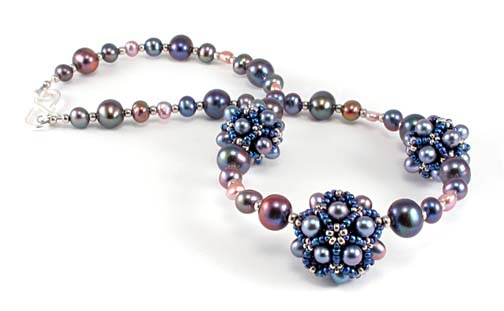
Several months ago, Florence Turnour and I decided to invite, Cindy Holsclaw (also known as beadorigami) to feature some of her beaded bead patterns on our website, beAd Infinitum.  We found her beaded bead designs to be innovative, beautiful, and well designed, so we were obviously thrilled when she decided to join us.  Today, we are releasing her newest pattern, the Balloon Box.

I made a Ballon Box while I was reviewing her pattern, and I must say, they are very satisfying to weave.  They are wonderfully tactile since they are a wee bit of squishy, yet they always spring back into place. I'm completely fascinated at how the Balloon Box looks with pearls and metallic seed beads.  Cindy, you found a beautiful way to update the pearl necklace!

MAA Poster

Here's the poster announcing an upcoming meeting for the Mathematical Association of America.  It has my bead work on it.  The bracelet is the Night Sky weave, and the beaded bead is from my soon-to-be-released Ionic Polyhedra pattern.
Related Posts Plugin for WordPress, Blogger...